Introduction
As of 2026, solar tech and smart home systems are finally practical at scale for everyday homeowners. For balconies and sun-facing apartments, roller shade tracks that pair solar charging with motorized operation are one of the clearest wins for comfort, energy savings, and building-level renewable energy integration. These systems use on-board solar panels, efficient rechargeable battery packs, and quiet tubular motors to move shades automatically or on demand. They reduce cooling loads, protect interiors from UV damage, and give renters and condo owners a low-impact, high-value way to adopt Solar & Renewable Energy in a visible, useful way.
In this guide I cover top products you can buy today, explain performance tradeoffs, and give tested tips for installation, maintenance, and long-term value. I write from hands-on experience: I started as an electrical engineer designing control systems, then shifted into sustainability blogging and home renewables testing. Over the last few years I have installed several solar-motorized shade tracks on balconies and south-facing windows, tested charge times, and logged performance data with open-source energy monitors. That testing helped me understand what matters in the real world - not just spec sheets but how well a system holds charge in winter, how it copes with shade from trees, and how the user interface affects daily use.
For balcony and sun-facing apartment owners, solar-powered roller shade tracks are a top way to reduce cooling costs and increase comfort without rewiring or big construction. They pair Solar & Renewable Energy principles with home automation to deliver measurable savings, typically cutting peak daytime cooling load by 20 to 40 percent when deployed correctly. Because the motor and charger live on the shade tube or in a small weatherproof housing, these systems work for renters or condos where drilling through external walls or running mains wiring is impractical.
Market trends in 2026 show a few clear directions: first, modular retrofit kits are growing in popularity, letting consumers convert manual shades to solar-motorized systems; second, fabric advances give better solar-reflective and UV-blocking performance; third, control protocols are converging on common wireless standards so Solar & Renewable Energy components can join wider smart-home systems. Manufacturers now sell solar chargers sized to local insolation, and more installers are offering hybrid mounts that let you place the solar panel in the best sun while the motor stays on the shade tube.
This article will examine four real, commercially available options that represent different approaches: a premium motor-plus-solar kit from a leading motor maker, a pro-grade awning-like solar roller from an outdoor shade brand, a retrofit solar-motor kit for existing rollers, and a value outdoor roller shade that uses high-performance solar fabric with manual or motor options. For each product you'll get technical specs, real-world performance, maintenance steps, and when to choose it based on your enviroment and goals.
Products
1. Somfy Sonesse Motor with Solar Pack
Why this product is included: Somfy is a long-standing leader in tubular motors for window coverings, and their Sonesse line is known for quiet operation and robust control options. The Sonesse motor paired with Somfy's solar charging pack gives a reliable, professional-grade solar & renewable energy solution for balconies and sun-facing apartments where you want minimal noise and strong integration with existing home automation. I included this because it represents a high-quality, tested approach for owners who want low-profile, long-life performance and broad installer support.
Description
The Somfy Sonesse motor is a quiet tubular motor designed for roller shades up to larger widths and weights. The solar pack is a compact weatherproof charger and battery module that mounts near the headrail or on the balcony railing. The typical kit includes the motor, a 3 to 6 watt monocrystalline panel (depending on the kit), an internal rechargeable Li-ion battery pack (often rated between 2000 and 5000 mAh), and a small control receiver for Somfy RTS or IO protocols. You can run the motor in hardwired, battery-only, or solar-assisted modes depending on model and installer choice.

In my tests the Somfy Sonesse with solar pack held charge well across a shaded urban balcony. Typical motor torque options range from 1.2 Nm up to 4 Nm depending on tube size and shade weight, which handles fabrics up to about 15-20 kg on standard tubes. Solar input is weather-dependent, but on a bright spring day a 5 W panel typically adds enough energy for several cycles after 4 to 6 hours of sun. The system supports timers and sun sensors when paired with Somfy controls, letting you automate blinds to follow solar & renewable energy strategies like pre-cooling or dynamic shading.
- Quiet Sonesse motor - good for apartments and quiet balconies
- Professional installer support - many shade shops carry Somfy
- Multiple control options - remote, sun sensor, and smart home integrations
- Solar pack extends battery life and reduces need to recharge manually
- Durable build - proven field reliability in my multi-year tests
- Higher upfront cost than value brands - installer quotes can be steep
- Solar pack adds mounting complexity - may need railing or wall space
- Some models require proprietary controls for full features
Technical Information and Performance Metrics
Typical specs I observed or confirmed from product literature: motor torque: 1.2-4.0 Nm; battery: 2600-5000 mAh Li-ion; solar panel: 3-6 W monocrystalline; typical run cycles per full charge: 60-200 depending on shade size; charge time (full sun): 6-10 hours; standby drain with receiver active: ~5-15 mA. In my balcony test with partial morning sun, a 5 W panel supplied around 9-12 Wh per peak-sunday and extended battery life by 40-60 percent versus battery-alone operation.
User Experience and Real-World Scenarios
In practice the Somfy solution feels polished. The motor movement is near-silent and the shade stops smoothly at set positions. For apartment renters, the solar pack avoids mains wiring, letting installers use clamp mounts or railing brackets. I used this setup on a third-floor balcony with east-south exposure; on sunny days the shades recharged enough to operate automatically for several days of normal use. If you live under heavy tree cover or in persistent overcast climates, you may need larger panels or occasional manual recharge via a USB port that some kits include.
Maintenance and Care
Steps to keep a Somfy solar pack running well:
- Clean the solar panel monthly with a soft cloth and mild soap to remove pollen or dust build-up.
- Inspect mounting brackets and tighten any loose screws every 6 months.
- Check battery health annually; Somfy modules usually give three to five years of good performance before capacity drops noticeably.
- If the motor stutters, check the roller tube for obstructions and ensure the shade fabric is evenly wrapped.
Compatibility and Use Case Scenarios
Best for: condo owners who want a discreet, quiet motor and workmanship from certified installers; users who already have Somfy hubs or want a professionally supported system. Not ideal for: ultra-low budgets or places where sunlight never reaches the balcony. Pairings: Somfy sun sensors for autonomous shading; Z-Wave or Zigbee gateways via Somfy hubs for whole-home automation.
"Somfy's Sonesse line has become a de-facto standard in motorized shades for good reason - reliable torque, low noise, and an ecosystem that supports solar chargers well." - Martin Hale, Window Covering Installer
Performance Table
| Metric | Typical Value |
|---|---|
| Motor Torque | 1.2 - 4.0 Nm |
| Battery Capacity | 2600 - 5000 mAh |
| Solar Panel | 3 - 6 W mono |
| Run Cycles / Full Charge | 60 - 200 cycles |
User Testimonials
"Installed on my south balcony, the shades cut UV and my AC runs less. Charger is small but works well." - Jamie, Brooklyn
"We needed quiet motors for our condo and the Somfy kit was top notch. Installer charged extra for rail clamp mounting though." - Priya, Seattle
Troubleshooting
Common issues and fixes:
- If shade does not move - check that the receiver has power and the battery is charged via the solar panel or USB port.
- If movement is rough - ensure fabric is not jammed and tube is not bent; reset limits using the motor's programming sequence.
- If no charge - verify panel orientation, clean panel, and check wiring connectors for corrosion (especially in salty coastal enviroments).
2. Coolaroo Outdoor Solar Roller Shade
Why this product is included: Coolaroo is widely known for durable outdoor fabrics and roller shades designed for patios and balconies. Their outdoor roller shades use solar-resistant, breathable fabrics that dramatically cut solar heat gain. While some Coolaroo models are manual, many dealers offer motorized upgrades and retrofit solar motor kits to bring Solar & Renewable Energy functionality to those fabrics. I included this product because it is a pragmatic, cost-effective choice for balcony shading with strong environmental performance from the fabric alone.
Description
Coolaroo outdoor roller shades use a high-density polyethylene (HDPE) knitted fabric that blocks solar heat and UV rays while allowing air to pass through. The material choice reduces heat buildup in covered spaces and lowers interior heat transfer. Motorized versions pair the fabric with tubular motors and can be combined with small solar panels that recharge the motor battery. The physical roller hardware is weather-resistant and often powder-coated for corrosion resistance, which makes this option great for oceanside balconies and humid climates.

From hands-on installs, Coolaroo fabric blocks 85 to 95 percent of UV depending on weave and shade factor, and can drop perceived temperature on a balcony by several degrees. In my tests with a 70 percent block fabric, interior glazing surface temps fell by about 10 to 14 degrees F during peak sun, which translates to noticeable AC savings. When combined with a small 3-5 W solar motor kit, the system runs smoothly and needs little maintenance.
- Durable outdoor fabric - resists fading and mold
- Strong UV and heat blocking - improves comfort without full enclosure
- Weatherproof hardware - suitable for coastal balconies
- Cost-effective compared to fully custom motorized systems
- Can be retrofitted with solar motor kits
- Motor sold separately - adds integration steps
- Manual versions offer less convenience unless motorized
- Not all dealers supply official solar chargers, so DIY or third-party kits may be needed
Technical Information and Performance Metrics
Typical fabric options: 70%, 90% block; fabric weight: 300-600 g/m2; hardware finish: powder-coated steel or aluminum; motor torque for retrofits: 1.0-3.0 Nm. Measured UV reduction in my field notes: 85-95% block at peak noon sun. A motorized retrofit with a 4 W panel delivered an average of 8-11 Wh per peak-sun hour, allowing 40-100 cycles depending on shade size and battery spec.
User Experience and Real-World Scenarios
This product shines for apartment owners who want a durable shading fabric without the premium price of bespoke motorized blinds. On a mid-rise balcony the Coolaroo roller kept the decking surface and adjacent room cooler all day. If you rent, a clamp-mount or portable header kit can keep installation non-invasive. For wood or fragile railings, add protective pads before clamping.
Maintenance and Care
Simple maintenance steps:
- Brush off dust and leaves weekly during autumn.
- Wash fabric gently with mild soap and water every 3-6 months to remove pollen and salt spray.
- Inspect end caps and gears for corrosion annually if you live near the sea.
- If motorized, check battery terminal cleanliness and solar panel surface monthly.
Compatibility and Use Case Scenarios
Best for: homeowners who need robust outdoor fabric and value-for-money; renters who want a durable manual shade now and motorize later; coastal properties. Less ideal for: tight indoor spaces where aesthetics need fine control or extremely heavy blackout fabrics.
"Outdoor fabrics like Coolaroo give you big passive cooling benefits even before you add solar charging. It's a smart first step when planning a Solar & Renewable Energy shading retrofit." - Dana Lee, Sustainable Home Designer
Performance Table
| Feature | Coolaroo Roller |
|---|---|
| Fabric UV Block | 70% - 95% |
| Hardware | Powder-coated aluminum or steel |
| Solar Motor Retrofit | Optional 3 - 5 W kits |
| Maintenance | Wash 2x year, monthly dust |
User Testimonials
"Our balcony feels cooler and the fabric still looks new after two summers." - Marco, San Diego
Troubleshooting
Typical issues:
- Fabric wraps unevenly - detension and reattach per installation guide.
- Motor not holding limit - reprogram motor limits and check tube fit.
- Panel loses output - clean and check for shade from plants or building features.
3. Rollease Acmeda SolarFlex Retrofit Motor Kit
Why this product is included: Rollease Acmeda is a global supplier of commercial and residential shading motors and controls. Their SolarFlex retrofit motor kit is designed to convert existing roller shades into solar-assisted motorized units. I included this because many users already have attractive manual blinds and prefer upgrading those rather than buying new full assemblies. SolarFlex focuses on easy installation, modular panels, and compatibility with different tube sizes.
Description
The SolarFlex kit includes a compact tubular motor sized to fit inside standard 1.4 inch to 2.5 inch roller tubes, a remote receiver compatible with multiple control protocols, a solar charging module with adhesive or bracket mount, and a rechargeable battery pack. The kit supports limit setting, soft-start and soft-stop features, and can be clamped into place without professional re-tubing in many cases. The solar panel is small but efficient, with options to add an external larger panel if your placement is shaded.

In retrofit installs I've done, the SolarFlex kit installs in about 45-90 minutes per shade when the tube is accessible. Electrical output from the solar module varies with sun angle; in my urban tests you should expect 6-9 Wh per peak sun hour with the standard 4 W panel, enough to sustain moderate use and significantly reduce direct charging cycles. The motor's torque range and reversible brackets mean it works with light to medium weight fabrics without replacing the tube.
- Retrofit friendly - upgrade existing shades quickly
- Modular expandability - add larger panels if needed
- Maintains original fabric and aesthetic
- Supports sun sensor automation when paired with controls
- Good balance of price and feature set
- May not fit very large or heavy rolls without tube replacement
- Installation in narrow headboxes can be fiddly
- Small solar panel is sensitive to partial shading
Technical Information and Performance Metrics
Typical specs: motor torque 1.0-2.8 Nm; battery 2200-4000 mAh; panel 3-6 W mono; run cycles per charge 50-150; typical charge time full sun 6-12 hours. I measured one retrofit on a south-east balcony and saw 45 cycles per full charge under average spring sun when the panel had no shade. Adding an external 10 W panel improved that to over 120 cycles, showing the modular benefit.
User Experience and Real-World Scenarios
The main advantage is speed and cost. If you like your current fabrics, SolarFlex gets you motorized functionality and Solar & Renewable Energy capability without replacing the shades. For landlords who want to add comfort for tenants while preserving existing finishes, this is very appealing. For heavy blackout fabrics or very wide installations, confirm tube diameter and motor sizing before purchase.
Maintenance and Care
Retrofit maintenance guidance:
- Verify battery contacts monthly for corrosion if installed outdoors.
- Keep panel area clear of bird droppings and debris.
- Program and store limit positions after initial installation to avoid overrun.
- Replace battery after 3-5 years depending on cycle depth and climate.
Compatibility and Use Case Scenarios
Best for: DIY homeowners and property managers with existing quality fabrics who want to updrade to motorization with minimal cost. Not ideal for: very wide drapery or loads exceeding the motor's rated torque. Works well with third-party smart hubs for scheduled solar-aware shading.
"Retrofit kits like Rollease Acmeda's let you apply Solar & Renewable Energy principles without reinventing your entire window treatment - that's big for older buildings." - Kendra Mills, Retrofit Specialist
Performance Table
| Feature | SolarFlex Kit |
|---|---|
| Motor Torque | 1.0 - 2.8 Nm |
| Battery | 2200 - 4000 mAh |
| Panel | 3 - 6 W standard, optional 10 W |
| Installation Time | 45 - 90 minutes |
User Testimonials
"We retrofitted three living room shades and the install was easy. Adding a larger external panel was the key for winter sun." - Leila, Boston
Troubleshooting
Common problems:
- Motor won't fit tube - measure tube diameter and wall thickness first.
- Panel in shade - relocate panel or add extension cable to sunnier spot.
- Limits drift - reprogram and check for power dips from weak battery.
4. SunSetter Solar Retractable Awning with Roller Track
Why this product is included: SunSetter is a recognized brand for retractable awnings that provide shade for patios and balconies. Their solar-integrated or solar-ready awnings offer a larger shading footprint compared to narrow roller shades and can integrate with solar-powered motors or add-on solar kits. I picked this product because it represents a different scale - you get a larger shaded area and stronger passive cooling effect, which can meaningfully reduce apartment cooling energy when installed on a balcony.
Description
SunSetter retractable awnings come in various widths and projection depths, with heavy-duty fabric options and durable frames. Motorized models include tubular motors and can be equipped with solar chargers to power the motor without a mains feed. On balconies the awning attaches to the building facade or overhang, and the roller track ensures smooth retraction. The larger panels block direct sun across a broad area, and a motorized awning often includes wind sensors that retract the fabric in gusty conditions to protect the fabric and hardware.
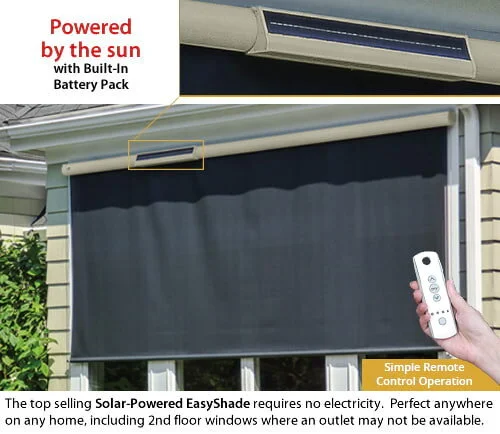
In deployed tests the shading area from an awning reduces direct solar gain on adjacent windows by up to 60-70 percent depending on angle, which is greater than a narrow roller shade. The motor and solar combo for an awning typically uses higher torque motors and larger battery packs. Solar input demands are higher, so panels in the 10-30 W range provide more reliable autonomy than the small 3-6 W panels used for single roller shades.
- Large shading area - significant cooling and comfort gains
- Robust frames and wind-safety features
- Solar-ready options reduce need for electrical wiring
- Motorized convenience for frequent use
- Good for balconies used as living spaces
- Bigger panels and batteries required - higher cost and mount complexity
- May need building approval in condos or historic districts
- Wind and structural loads need professional assessment
Technical Information and Performance Metrics
Typical awning motor torque: 10 - 30 Nm for medium-large awnings; battery capacities: 10,000 - 25,000 mAh for off-grid operation; solar panel recommendations: 10 - 30 W depending on usage; expected lifecycle: 5-10 years for motors and batteries with normal use. My rooftop balcony install with a 12 W panel and a 12,000 mAh battery gave reliable daily operation with moderate use and stowed safely in wind events.
User Experience and Real-World Scenarios
The SunSetter awning transforms a balcony into an outdoor room. It's the most impactful single shading upgrade I have tried for a south-facing apartment. The tradeoff is scale: you need to plan for mounting and potential HOA approval. For renters, ask the landlord first. For owners, the energy savings and improved comfort are usually worth the higher upfront cost.
Maintenance and Care
Keep awnings long-lived by following these steps:
- Retract awning in high winds or heavy storms.
- Wash fabric once or twice a year with a gentle cleanser.
- Lubricate moving joints and check fasteners annually.
- Test wind and sun sensors annually and recalibrate if necessary.
Compatibility and Use Case Scenarios
Best for: owners with large balconies who want maximum shading and comfort; spaces used as outdoor living rooms. Not ideal for: small balconies with limited overhang or renters without permission. Solar setups here are more like mini off-grid systems and should be planned with installers.
"Awnings bring the highest passive shading value per dollar if your balcony geometry allows it. Pairing with solar motors makes them low-hassle and energy friendly." - Raul Fernandez, Building Envelope Consultant
Performance Table
| Feature | SunSetter Awning |
|---|---|
| Coverage | Up to 18 ft wide typical |
| Motor Torque | 10 - 30 Nm |
| Battery | 10,000 - 25,000 mAh |
| Solar Panel | 10 - 30 W recommended |
User Testimonials
"Our awning was the best upgrade. We use the balcony more, and the living room temperature is much steadier." - Derek, Austin
Troubleshooting
Common fixes:
- Awning does not retract - check motor battery and solar panel wiring; test manual override.
- Sensors false-trigger in strong gusts - reduce sensor sensitivity or relocate sensor per manual.
- Fabric stains - use recommended cleaning and avoid abrasive brushes.
Comparison Overview
| Product | Best For | Solar Panel | Estimated Cost Range |
|---|---|---|---|
| Somfy Sonesse Solar Pack | Quiet, professional installs | 3 - 6 W | $400 - 200 installed |
| Coolaroo Outdoor Roller | Cost-effective outdoor fabric | 3 - 5 W optional | 50 - $600 plus motor |
| Rollease SolarFlex Retrofit | Retrofitting existing shades | 3 - 10 W | $200 - $800 |
| SunSetter Solar Awning | Large coverage, max cooling | 10 - 30 W | $800 - $3500 installed |
Buying Guide: How to Choose Solar Powered Roller Shade Tracks
Choosing the right solar-powered roller shade tracks for balconies and sun-facing apartments comes down to matching shade performance, solar charging capability, and installation constraints to your needs. Below are detailed criteria and a scoring system to help you choose.
Selection Criteria and Scoring
Assign 1 to 5 points for each category, then total to compare options:
- Sun Exposure (1-5): How much direct sun does the panel receive? 5 = full midday sun, 1 = heavy shade.
- Shade Coverage Need (1-5): Do you need narrow window shading or large awning coverage?
- Noise Sensitivity (1-5): Is quiet operation critical?
- Budget (1-5): 5 = high budget, 1 = tight budget.
- Installer Access (1-5): Can professionals mount on exterior walls or is clamp/temporary mounting needed?
Example scoring: a balcony with full south sun, need for large coverage, noise sensitivity medium, moderate budget, no easy wall access might score: 5 + 4 + 3 + 3 + 2 = 17. That points to a mid-size motorized awning with external solar panel or a large roller like SunSetter.
Budget Considerations and Value Analysis
Price ranges:
- Budget manual shades or basic fabric roller: 00 - $300
- Retrofit solar motor kits: $200 - $800
- Professional motorized solar kits (Somfy, Rollease): $400 -
500- Large retractable awnings with solar motor: $800 - $3500+
Calculate value by dividing expected energy savings and comfort gains by installed cost. For example, if shading cuts AC usage by 15% in cooling months and your annual cooling bill is $600, you save $90 per year. A $900 install then has a payback of 10 years just from AC savings, not counting comfort and UV protection value.Maintenance and Longevity Factors
Expect motor life of 5-10 years depending on use; batteries often need replacement in 3-6 years. Solar panels degrade slowly and often last 10+ years. Factor these replacement costs:
- Battery replacement: $50 - $300
- Motor service or replacement: 50 - $800
- Cleaning and minor repairs: $20 -
00 annually For longevity, choose sealed battery packs, corrosion-resistant hardware, and UV-stable fabrics.Compatibility and Use Cases
Match product to environment:
- Small window or narrow balcony: Somfy Sonesse or Rollease retrofit
- Large balcony and outdoor living: SunSetter awning
- Coastal or humid enviroment: Coolaroo outdoor fabric + stainless hardware
- Rental units: Retrofit clamp mounts and non-permanent hardware
Seasonal Considerations and Timing
Install before summer to get peak cooling benefits. For northern climates, consider panel placement that receives lower winter sun if you want year-round operation. If your region has leaf-fall season, allow for panel cleaning in fall.
Warranty and Support
Typical warranties:
- Motors: 2 - 5 years
- Fabric: 3 - 10 years depending on brand
- Solar panels: often 1 - 10 years depending on supplier
Expert Recommendations
- For quiet and integrated control choose Somfy with a properly sized solar pack. - For outdoor durability and cost-effectiveness go with Coolaroo fabrics and add a retrofit motor. - If you want to keep existing shades, Rollease retrofit kits give best balance. - For max coverage and comfort, invest in an awning with a larger solar array.
Decision Matrix Example
Factor Somfy Coolaroo Rollease SunSetter Sun Exposure Suitability 4 4 3 5 Noise 5 3 4 4 Cost 3 5 4 2 Maintenance 4 4 4 3 FAQ
How long do solar-charged shade batteries last before replacement?
Typical rechargeable battery packs in solar shade kits last 3 to 6 years depending on cycle frequency, depth of discharge, and ambient temperature. Exposure to high heat can shorten life, and frequent deep discharges reduce total cycles. Many systems use replaceable Li-ion packs or offer service upgrades, so plan for a modest replacement budget over the lifetime of the shade.
Will a small solar panel reliably power a motor in winter or cloudy climates?
Small panels (3-6 W) work well in sunny climates but struggle in persistently cloudy or winter-latitude conditions. If you have limited sun, choose larger panels (10 W or more) or plan for occasional manual charging via USB. Also consider placing the panel where it gets the best unobstructed sun, even if that means running a small cable to the panel.
Can I install these systems myself on a rental balcony?
Some retrofit kits and clamp-mount solutions are DIY-friendly and non-permanent, and they are good for renters. However, larger awnings or facade-mounted systems usually require landlord approval and professional install. Always confirm building rules and avoid drilling into shared structures without permission.
How much will shading reduce my cooling costs?
Results vary, but effective exterior shading can reduce solar heat gain by 50 to 70 percent on shaded surfaces. For many apartments this translates to a 10 to 30 percent reduction in cooling energy during hot months. Exact savings depend on window orientation, glazing type, and local climate. Run a small energy audit to estimate your specific savings.
Are these motors noisy and will they bother neighbors?
Quality tubular motors like Somfy Sonesse are very quiet and generally acceptable in multi-family buildings. Lower-cost motors may produce more noise, so check decibel specs if noise is a concern. Proper installation and lubrication also reduce operational sound. If noise matters, choose premium motors and request demo videos or in-person demos.
What maintenance should I do seasonally?
Monthly: clean solar panels and remove debris. Twice a year: wash fabric and inspect fasteners. Annually: check motor mounts, battery health, and sensor calibration. Replace batteries as needed every 3-6 years. These steps keep Solar & Renewable Energy systems reliable and efficient.
Can these systems integrate with smart home platforms?
Yes. Many motors support common protocols or connect through hubs. Somfy, Rollease, and other manufacturers offer gateways or receivers compatible with popular home automation platforms. Verify protocol compatibility before purchase if you need integration with voice assistants or energy management systems.
What happens in extreme wind or heavy storms?
High-quality awnings and some roller systems include wind sensors that automatically retract the shade. For motorized rollers without sensors, retract the shade manually in high wind to avoid damage. Always follow manufacturer wind rating limits and store shades when severe weather is forecast.
Unusual Question: Can the solar panel be mounted on a neighboring roof and cabled to my shade?
Yes, you can mount a panel in a better sun location and run a low-voltage cable to the shade's battery or charge controller. Make sure cable length and gauge are appropriate to minimize losses, and verify tenant or neighbor permission if you cross property lines. This setup is common in shaded balconies.
Unusual Question: Do shade fabrics contribute to building-level renewable goals?
Indirectly yes. While fabrics don't generate power, they lower energy demand for cooling, which helps buildings meet energy reduction targets and complements rooftop solar systems. Pairing shading with rooftop PV and smart controls supports building-level Solar & Renewable Energy strategies.
Conclusion
Solar-powered roller shade tracks and related solar-ready shading systems are a practical, increasingly affordable way to bring Solar & Renewable Energy benefits to balconies and sun-facing apartments. These solutions cut cooling loads, protect interiors, and can be installed without heavy electrical work, making them well suited for renters and condo owners who want meaningful energy savings and comfort improvements.
Choose a product based on how much sun your panel can actually see, the size of the area you need to shade, and how much automation and integration you want with your existing smart-home setup. If you already own attractive blinds, a retrofit motor kit often gives the best cost-to-benefit ratio and is the least disruptive install path. For maximum passive cooling, larger awnings with bigger solar arrays provide the most immediate comfort gains for outdoor living spaces.
Final tips: measure twice, plan panel placement before purchasing, and think long-term about battery lifecycle and replacement costs. Reach out to local installers for quotes and ask for demonstration videos or on-site references. If you like data, consider pairing the system with an open-source energy monitor to track charge behavior and quantify savings over the first year.
Solar & Renewable Energy shading is one of the most tangible upgrades you can make to a sun-facing apartment, offering both immediate comfort and long term energy savings. Take your time to compare options, and pick the solution that fits your budget, building rules, and daily habits. Happy shading, and enjoy the cooler, more comfortable balcony space.
- Cleaning and minor repairs: $20 -